Wednesday, February 19, 2025

Mise-en-scene: Set

Where it all occurs is one of the most significant things to consider when telling a story using a movie. The story itself depends in great part on the surroundings. It may affect the tone of the story, help us to discern the personalities, and even contribute to the narrative. Consider it as the room that surrounds everything else going on in the narrative.

The set is in my partner's room for our narrative, and it is the ideal site to gather everything. Layla's mental state will be reflected in the room. This is an emotional terrain reflective of the grief and battle of the character; it is not only a bedroom. We are helping to produce a world that seems like it could be of someone you know by giving the scene a living, realistic touch.

Layla's room will not be cheery or light as she is mourning deeply. It will be somewhat disorderly, much like her brain. Her past will reveal ignored awards and forgotten pastimes, which will be evidence of how much she has changed since her brother's death. The room should feel left, a location where Layla has ceased to maintain her surroundings and herself. The lighting and the angles the room is shot will further assist in conveying the isolation and grief.

The room will let us know much about Layla's interior world. The dusty, neglected space will reveal just how much she is trying to maintain everything together. We could even see a photo or memory link her to her brother—something that would help us remember who she used to be before everything changed. The collection itself becomes a personality, revealing to us what is happening inside Layla's core.

For this narrative, my partner's room sets will really bring Layla's emotional trip alive. It is an expansion of her mourning, her solitude, and the chance for her to rediscover herself—not just a physical area. The room will transform with the character, therefore making it as vital to the plot as the character herself.



Monday, February 17, 2025

Meet Layla

Meet Layla

I had a hard time choosing a name for my character because I wanted it to fit her perfectly. I checked so many websites, meanings and after a long search I found the name Layla. It means “dark as night” in Arabic and that fits her so well. Layla is dealing with a lot of grief and I wanted her name to reflect that. I kept looking just in case but I knew Layla was the right choice.

Layla’s Look and Personality

Layla has a dark style to match how she feels inside. She was really close to her brother and losing him changed her. My partner and I are still deciding if she’ll wear a bracelet or necklace to remind her of him but whatever we pick will be important to her character.


Her personality will show through her clothes, her room and the way she acts. She doesn’t talk about her grief but you can see it in everything around her. Her room is messy, full of things she used to love but has stopped caring about. She used to have hobbies and interests but after her brother’s death she let them go.

Layla’s Struggles

Because of problems at home and what she’s dealing with inside Layla turns to drinking to cope. It slowly makes her lose herself, pushing her further from who she used to be. Her room reflects this with dusty trophies and forgotten achievements showing how much she’s changed. Her story is about her struggling but we also want to show a small moment of hope – maybe something that hints she still wants to find herself again.

We want Layla to feel real, like someone people can connect with. She’s not just grieving; she’s lost and her journey is about finding her way back.

Sunday, February 16, 2025

Storyboarding

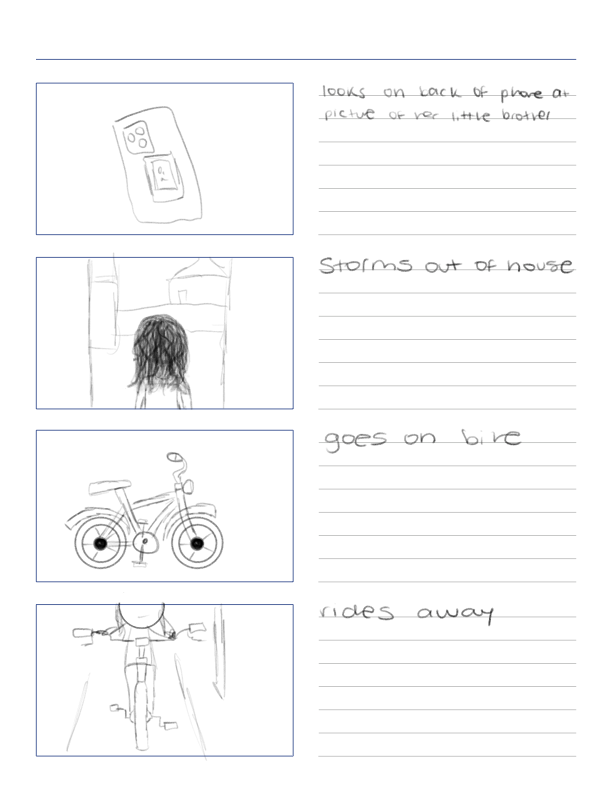
The next step in my project is storyboarding. Storyboards help organize ideas and provide a visual plan, regardless of drawing skills. They’re helpful not only in the pre-production stage when you’re developing your ideas but also during production. When you're filming, things can become overwhelming. You might lose sight of the shots you need or what best advances the story. A storyboard serves as an anchor, keeping everything in check by showing the shots you planned and their significance; you might lose sight of the shots you need or what best advances the story. Here is my storyboard:


Friday, February 14, 2025

Film Opening Plot

After having researched the genre and figuring out the tone i want for my film opening, I officially have the plot. The story is going to be sad and emotional with a strong character struggle. I don't really do projects like this but i thik it can be fun to explore new tones and plots.

The story is about a teenage girl dealing with the loss of her younger brother due to suicide. She hears her parents arguing all the time, blaming each other on the brothers death. She has a lot of greif in her and finds an easy way out.

The film starts out with her lying on her bed, surrounded by pictures, hobbies, and things she used to love. She doesn’t do them anymore after the death of her brother she was lost and disconnected from everything. Then she walks out of her room and hears her parents fighting. They yell at each other, blaming each other for their son's death. She can’t take it and runs back to her room, grabbing the last of the alcohol she has, and sneaks out.


She rides her bike to meet someone who has more alcohol for her. The shots focusing on the various emotions she gets the whole time. She isn't just getting away, shes trying to escape reality for as long as she can.

These scenes gives me a lot to work with emotionally and visually in just two minutes. Now that I have the basic plan, I can work on the details and develop the character more. I’m excited to see how this turns out!

Wednesday, February 12, 2025

Media Theory

Todorov's Narrative Theory of Equilibrium states that is how stories can be structured. A story is divided into three large areas: Equilibrium, Disequilibrium, and New Equilibrium (Media-Studies.com 2024; FilmTheoryExplained.net 2024). 

Equilibrium is the state at the start of the story: everything is normal and characters have nothing to worry about in their lives. This gives life before anything happens.

Disequilibrium is a time when a thing happens to disrupt normal life, such as a major event, a problem, or an inner struggle for the protagonist. This is the most tense bit of the story and drives it forward.

New equilibrium is when the story arrives at a resolution. Things will not be as they were, but a new balance is created. Characters have altered or adapted in some way. This scene is used to close and finally give an ending to the audience.

Todorov's theory inspires many films, books, and TV shows to develop attractive storytelling. These three stages will also direct the narrative flow and audience engagement (Media-Studies.com 2024; FilmTheoryExplained.net 2024).


Tuesday, February 11, 2025

First Group Meeting

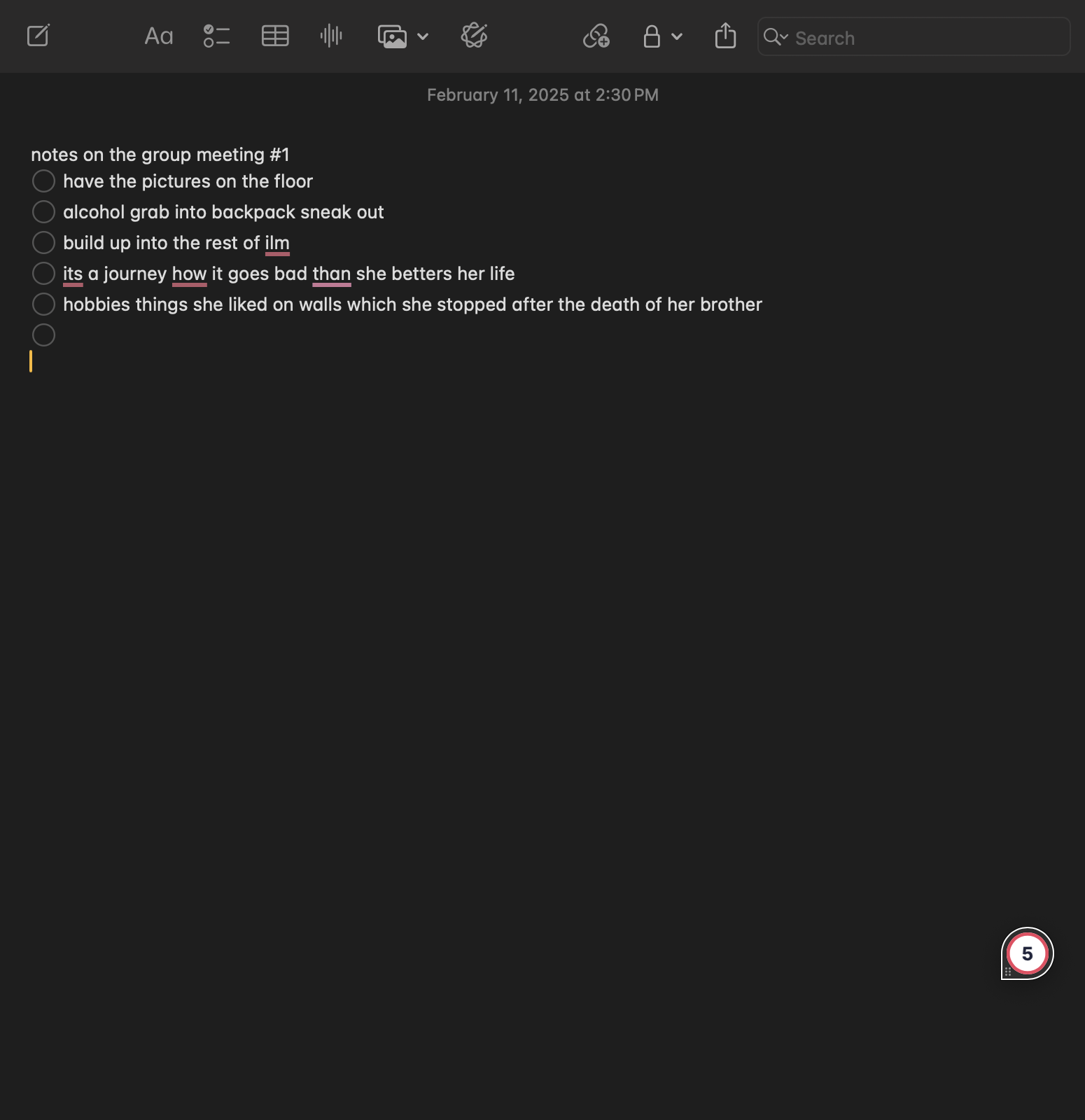
The first group meeting brought together people from different groups to share ideas, help each other improve our film openings, or even suggest new ones. This helped us develop our stories and get useful feedback. Some ideas they suggested for my film opening were:


To open the film with pictures scattered on the floor. This will create a sense of loss or chaos. The visuals will help show the main character’s emotions and hint at her past.

To get the protagonist grab the alcohol she has in her room and put it into a bag and sneak out with it. This will help show the bad things she is doing to get over the death of her younger brother.

The story should show how it will build up into the rest of the film. Even though its is only the opening, hinting at how the protagonist’s journey will develop, starting in a dark place but showing the change for a better life.

They shared the idea of hobbies and interests she gave up after her brother’s death. This could be shown with old drawings, sports gear and trophies, or instruments on her walls, untouched. This will show the grief and lost identity, the character is going through.

Now with all of these ideas i need to get with my partner and share with her these ideas and she can share hers with me and we can pick and combine ideas together for our film. While I am not sure if these ideas fit our vision, they helped me think about different ways to tell the story.

Sunday, February 9, 2025

Music Research For My Film Opening

A film's tone is greatly influenced by its soundtrack. I need music that complements the sadness, tension, and escape moments when the girl sneaks out for my story about her coping with her brother's death. I want music that reflects the tension from her parents' conflicts, her anguish over losing her brother, and her sense of liberation when she escapes all the chaos. 

I'm searching for instrumental music that enhances the narrative without drowning out the conversation. I like a slow tempo that captures the scene's tension and grief while combining raw and calm sounds that show the protagonist's inner suffering and her sense of freedom as she escapes away.

Examples of Music That Might Fit

• Lorde – "Liability" (Instrumental): This track’s emotional tone mirrors the protagonist's grief and sadness.


• Max Richter – "On The Nature of Daylight": This piece builds gradually and has a sorrowful, emotional quality that would suit the story's mood.


• Ólafur Arnalds – "Saman": A gentle mix of piano and electronic sounds that creates a calm yet intense atmosphere.


• Ludovico Einaudi – "Experience": This piano composition unfolds over time, perfectly embodying the protagonist’s journey through pain and escape.


Next Steps

I'll start listening to songs by new artists or think about some well-known songs that fit now that I know more about the kind of music I want. I want to make sure the music complements the dramatic parts because it has a big influence on how the viewer feels about the narrative.

Critical Reflection

The music video succeeds in portraying the emotional situation of heartbreak, introspection and self-development especially through the eyes...